.png)
 2 hours ago
2
2 hours ago
2

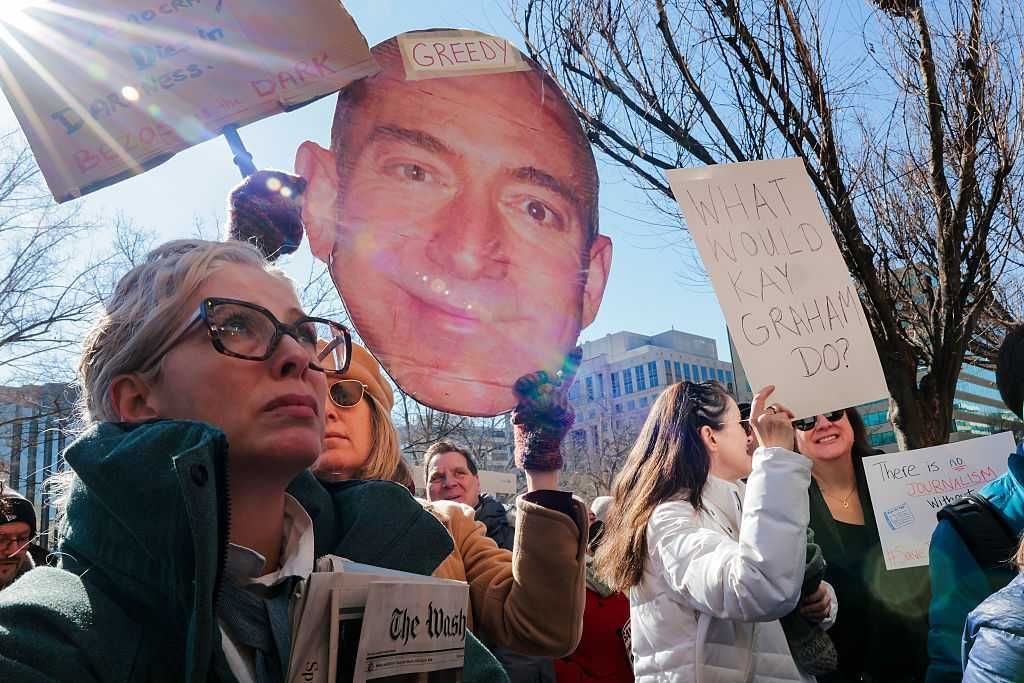
The Washington Post just laid off more than 300 employees — roughly 30% of its newsroom — cutting back sports, local coverage, international reporting, and books. The paper has shed staff before, including a reduction in 2025 and voluntary buyouts, as losses piled up. Reports put the Post’s losses at $177 million over the past two years, with annual deficits topping $100 million since 2023.
Predictably, fired staffers and their allies blame owner Jeff Bezos for refusing to write blank checks indefinitely. They want the world’s fourth-richest man to underwrite their failing business model forever.
Downsizing isn’t a tragedy. It’s a market verdict.
But that’s not the story. The Post didn’t collapse because Bezos got cheap. It collapsed because its newsroom got ideological — and readers stopped trusting it.
The Post built its modern reputation on tough reporting and institutional seriousness. Then its editors and writers started injecting personal politics into straight news, smuggling advocacy into headlines, and treating dissent as moral failure. That approach earned applause inside the Beltway, but it bled credibility outside it. Readers left. Subscribers disappeared. Revenue followed.
Immigration coverage captures the pattern.
In 2018, the Post ran a story headlined “How Trump is changing the face of legal immigration.” The piece claimed an 81% drop in arrivals from Muslim-majority countries and a 12% overall decline in legal immigration, framing the change as a deliberate demographic overhaul. The story leaned on cherry-picked State Department numbers that covered only part of the admissions system while ignoring other federal data. The paper dressed activism up as analysis and called it news.
That same year, the Post published “U.S. is denying passports to Americans along the border, throwing their citizenship into question,” implying a broad campaign of anti-Hispanic discrimination. The story suggested “hundreds, possibly thousands” faced baseless fraud accusations tied to midwife-assisted births.
The piece ignored the long history of documented fraud in those cases and left readers with a clear impression: The Trump administration targeted Hispanics. In fact, denial rates actually fell under Trump — from 35.9% in 2015 to 25.8% in 2018. The Post later appended an editor’s note acknowledging errors challenged by the State Department. That kind of walk-back never repairs the original damage.
In 2024, the habit remained. The Post accused Republicans of “misleading ads” about the border while soft-pedaling the scale and timing of the Biden-era surge. It scolded language choices, such as “illegals” and “harsher,” framed enforcement as cruelty, and applied different standards depending on which party spoke.
This isn’t just an immigration problem. It’s a newsroom culture problem.
RELATED: Bernie Sanders gets obliterated online for dragging Melania into left-wing criticism of WaPo layoffs
 Photo by Demetrius Freeman/The Washington Post via Getty Images
The Post’s rush to judgment during the Nicholas Sandmann incident in 2019 showed how quickly narrative can replace verification. The paper treated a Kentucky teenager as a national symbol of Trump-era racism based on a misleading clip, then watched the fuller video upend the story. The Post paid an undisclosed settlement. The reputational hit lingered.
That pattern — moral certainty first, facts later — has infected much of corporate media. CNN, the New York Times, and their peers keep hemorrhaging trust because they keep selling ideology as “objective” reporting. They blur the line between news and opinion, then act shocked when audiences treat them as partisan actors.
That distortion carries consequences beyond subscriptions. When media outlets portray immigration enforcement as inherently malicious and frame routine operations as persecution, they turn policy disagreement into moral panic. They train audiences to view law enforcement as an occupying force. That mindset fuels the kind of street-level provocation that turns tense encounters into tragedy.
Journalism carries a sacred obligation: Tell the truth plainly, verify before amplifying, and separate reporting from activism. Too many at the Post treated that obligation as optional. The audience noticed. Circulation reportedly plummeted to about 97,000 daily in 2025. Financial losses followed.
Downsizing isn’t a tragedy. It’s a market verdict.
If the Washington Post wants to survive, it must rediscover objectivity — or keep shrinking until only its own employees bother to read it.






 English (US)