.png)
 2 hours ago
4
2 hours ago
4


Why is the National Education Association encouraging students to skip school?
Yesterday was May 1 — May Day — and across the country, activists staged coordinated demonstrations under the banner of “no work, no school, no shopping.”
These are sweeping political claims, touching on immigration policy, cultural debates, and national partisan conflicts.
The National Education Association — with roughly 3 million members, making it the largest labor union in the United States — was among the organizations supporting the effort. On its website, the NEA offers organizational resources for participants, including a “solidarity toolkit.”
May Day? Mayday!
The union frames May Day as part of a long tradition of labor activism, tracing its roots to the late 19th-century movement for the eight-hour workday.
Broadly speaking, that’s true.
But May Day also carries a more complicated legacy. Over the course of the 20th century, it became closely associated with socialist and communist movements worldwide, and in the United States it has often re-emerged as a vehicle for broader political protest.
That broader agenda is evident in some of the demands the NEA highlights.
Among them:
- “Stop the billionaire takeover and rampant corruption of the Trump administration.”
- “Stop the attacks on our communities, including policies targeting immigrants, people of color, Native people, people with disabilities, and those who identify as LGBTQ+.”
These are not narrowly labor-oriented concerns. They are sweeping political claims, touching on immigration policy, cultural debates, and national partisan conflicts.
Mission creep
Which raises a more basic question: What does this have to do with the NEA’s stated purpose?
The organization describes its mission as “to advocate for education professionals and to unite our members and the nation to fulfill the promise of public education to prepare every student to succeed in a diverse and interdependent world.”
Encouraging participation in a day of protest framed explicitly around “no school” sits uneasily alongside that mission. And May Day is just the tip of the iceberg
According to a new report from watchdog group Defending Education, teachers’ unions have spent more than $1 billion on political activity since 2015 — including roughly $669 million at the federal level and $336 million at the state and local levels.
Some of that spending aligns with what most people would expect. In California, for example, unions spent more than $20 million backing Proposition 15, a 2020 ballot initiative that would have raised taxes on commercial properties to increase funding for public schools and community colleges. The measure ultimately failed.
But much of it extends far beyond that.
RELATED: 'Eco-Socialism' now! Inside Sunrise Movement's ‘revolution’ playbook
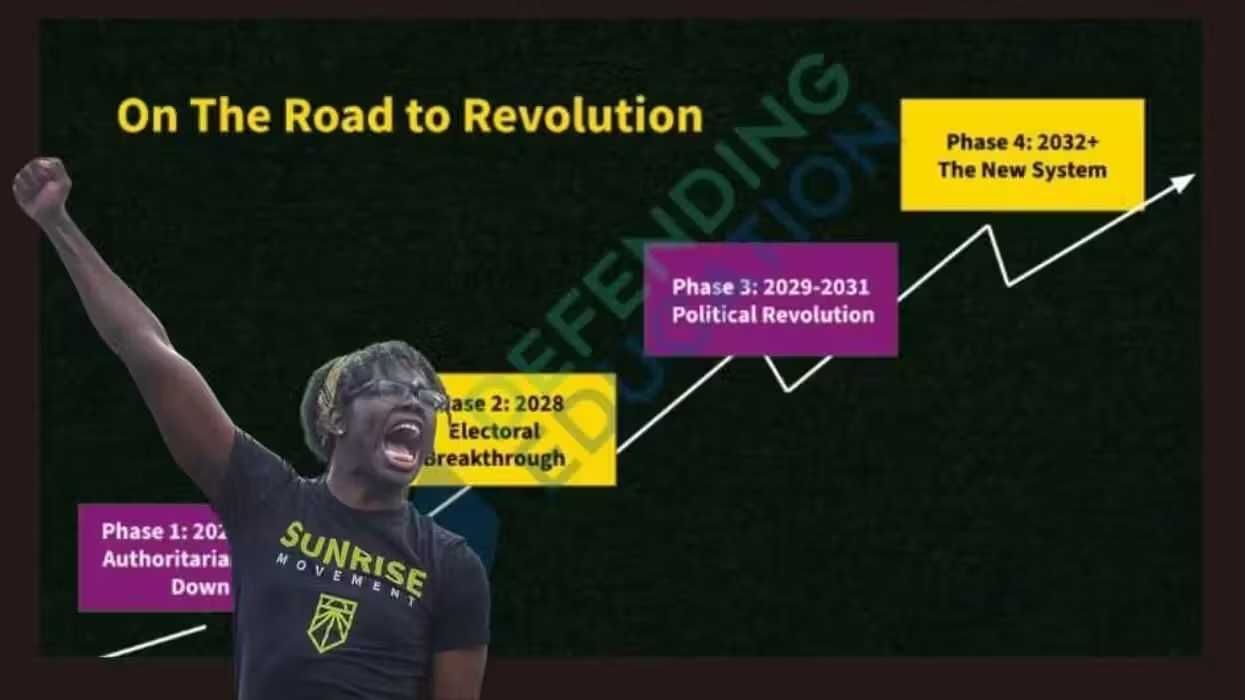 Defending Education | Robert Gauthier/Getty Images
PAC mentality
Defending Education's report highlights tens of millions directed toward major Democrat-aligned groups, including:
- $32 million to Senate Majority PAC.
- $25 million to House Majority PAC.
- $60 million to the State Engagement Fund, a progressive funding hub that supports state-level campaigns and advocacy.
- $44 million to For Our Future, a Democrat-aligned organizing group focused on voter turnout and elections.
At the state level, unions have also poured money into targeted political fights — opposing school choice initiatives, backing candidates, and influencing local school board races.
In California, union spending has extended into high-profile contests as well. The California Teachers Association’s PACs spent $1.8 million opposing the 2021 recall of Gavin Newsom and committed millions more to a 2025 ballot measure related to election policy.
The same report also points to funding for organizing groups like the Midwest Academy, which describes itself as "committed to providing organizers with the practical skills needed to address the challenges of forging change in a system rooted in white supremacy."
It has received $1.7 million from the NEA since 2015 and has helped produce activist training materials tied to sustained protest efforts.
Out of school
Teachers’ unions have always played a role in politics. When that role is tied directly to classrooms — teacher pay, school funding, working conditions — the connection is clear.
But as their spending and activities expand into broader political organizing, electoral campaigns, and now protest mobilization, that connection becomes harder to define.
Unlike most political organizations, teachers’ unions are funded by member dues — payments that many educators make as a practical requirement of their profession. That makes their political activity qualitatively different from a typical advocacy group or PAC.
The question isn’t whether unions should — or can — be entirely "apolitical." It is whether their current scope reflects the priorities of the educators who fund them — and the students they have pledged to serve.








 English (US)