.png)
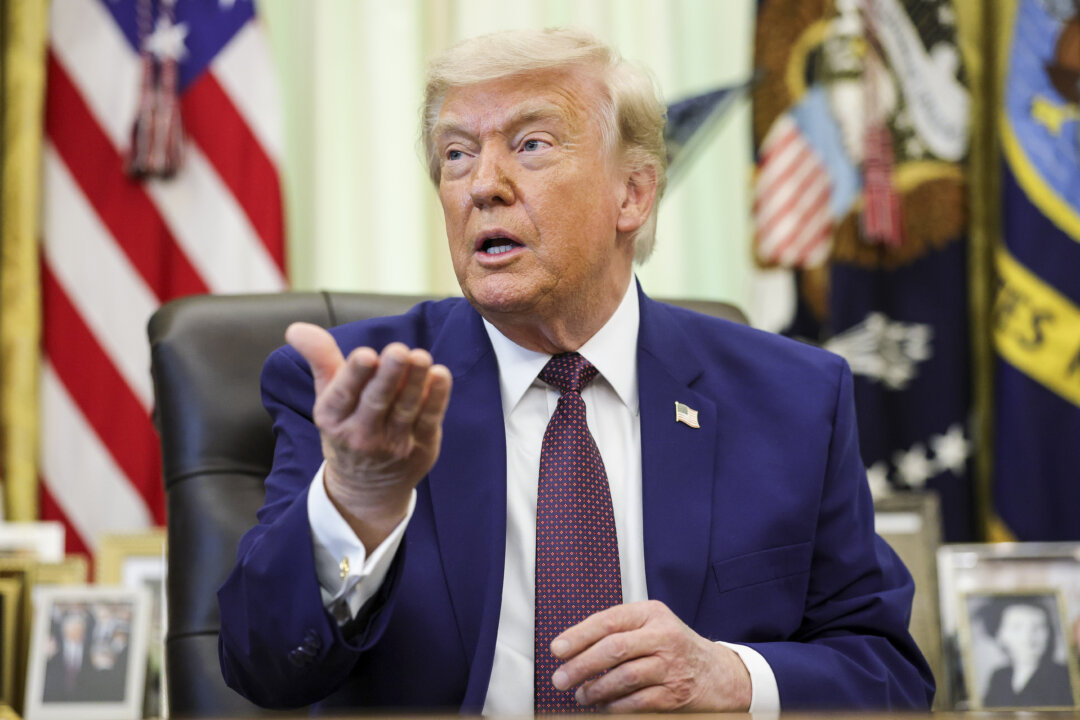
LONDON — Donald Trump and Keir Starmer will never be linked in the same fashion as political tandems Ronald Reagan and Margaret Thatcher or Bill Clinton and Tony Blair. But the two beleaguered leaders may be remembered for leaving the same legacy — demonstrating that their countries are both in desperate need of a cleansing.
Starmer is facing a revolt in his own party — he may be ousted by a man who’s not even in Parliament yet — and were Trump to submit to a secret confidence vote from his party’s senators, he’d likely confront a similar fate.
The British prime minister and American president are also unpopular with the general electorate in each of their nations. Their travails don’t just highlight the coincidental decline of the bland barrister and the rampaging reality star, however, but rather a deeper rot in the U.K. and the U.S.
There’s a crisis of faith in both countries. Voters turned to extreme measures a decade ago, Brexit in the U.K. and Trump in the U.S. Yet neither form of political shock therapy has offered deliverance, let alone been a panacea.
So two of Western democracy’s flagships keep turning over their leadership.
Britons have run through five prime ministers in the post-Brexit decade, and they could be on their sixth later this year, should Manchester Mayor Andy Burnham win a by-election later this month and ascend to the premiership. By comparison, in the 30 years preceding Brexit, Britain had just four prime ministers.
Americans are about to have three consecutive one-term presidents. And at least one chamber of Congress has changed hands in every federal election since 2018, a streak likely to continue this November.
Voters in both countries are impatient, irritable and deeply skeptical of traditional leaders and most every mainstream institution.
The wealth gap is ever-widening, and technology has simultaneously accelerated cynicism and expectations. People want a quick fix to address the cost of living, and when they don’t get it, their distrust grows, prompting another change election which only restarts the rinse-wash-repeat cycle.
And now comes the AI revolution, which, as Democratic strategist James Carville notes, is “the perfect issue for our time.” Why? Because AI screams, “They’re going to fuck me,” said Carville, who worked elections in both countries. The “they,” in this case, means the same mighty, if amorphous, powers blamed for the rest of society’s ills.
You may think I’m being overly pessimistic.
Well, healthy countries don’t find that just 17 percent of their citizens have faith in their government, as Pew found of Americans last year. Nor do they see nativists openly demonstrate by the tens of thousands in the streets of their capital, as was the case in Britain when far-right activist Tommy Robinson and his followers descended on London. (Of course, a proud, if defensive, Brit may note that multiple presidential assassination attempts don’t exactly reflect a well-functioning society, nor does the stunningly sizable belief that these events were staged.)
Governments in both countries have become tragicomedies.
Starmer’s Labour Party delighted in watching the Conservatives flounder, with their four prime ministers in eight years. Yet the same factionalism and voter pique that plagued the Tories is now swallowing Starmer. Those jokes about Liz Truss’ premiership not outlasting a head of lettuce won’t seem so funny if 10 Downing Street’s next would-be renter, Burnham, loses this month’s by-election and Labour is back to square one.
10 years after the U.K. voted to leave the European Union, the country remains just as discontented and divided. Any longtime observer of British politics can rattle off why, as many did when I was there last month: no real economic growth, stagnant salaries and the turbulence caused by the succession of Covid and wars in Ukraine and now Iran.
Then there are the more delicate but undeniable cultural rifts over immigration and identity, which have fueled a populist backlash. Not only did Brexit not make Britain great again, it only exacerbated public cynicism. The economy wasn’t lifted. And while detachment from the continent may have made it harder for the proverbial Polish plumber to migrate, it didn’t stop the arrival of non-white Muslims, whose influx has radicalized middle England.
Just consider the reaction on the right in the Brexit decade: from Boris Johnson to Nigel Farage to, now, Rupert Lowe and his Restore Party, which believes that Farage’s Reform is too soft on migration. That’s to say nothing of Robinson and his shock troops, who wave Union Jacks and St. George’s flags about as subtly as American segregationists once raised the Confederate banner. You can scoff at Lowe and Robinson as reflecting only the far-right extreme, but the richest man in the world, Elon Musk, isn’t dismissing the duo — he’s helping to fund them.
This sprint right, from Etonian shabby genteel to soccer hooligan bigotry, has upended the Conservative Party, as has been well-documented. Yet Britain’s local elections last month illustrated how Labour, too, is under siege from a sour electorate: They suffered losses on their old working-class right to Farage’s Reform Party, were nibbled in the center from the Liberal Democrats and weakened on the left by the Greens.
There may be no better evidence of deeper structural problems here than Starmer’s collapse, less than two years after his party returned to power. He lacks charisma and vision, but he’s about as inoffensive and stolid a character as imaginable. Yet he’s become the avatar for a failed government, inspiring a ferocity of ridicule and disdain I found hard to grasp until a shrewd student of politics here made it plain: It’s the algorithm, stupid.
The phone culture, what former U.S. Sen. Lamar Alexander calls “digital democracy,” has quickened and coarsened politics, warping the incentive culture for elected officials and a press playing catch-up while pushing everyday voters deeper into siloes.
Burnham, should he prevail, will face the same fundamental challenge as Starmer. Yet before Farage starts tipping his pint in glee, he should consider his own looming challenge in 2029, by when the next general election must be held. If Labour could be picked apart in every direction in local elections, couldn’t Reform suffer the same fate once Farage bears the burden of leadership and attempts to forge a campaign coalition between working-class Labour refugees, former Tories and the Restore fringe?
Which brings us back to America.
As my country nears 250 years of independence from the crown, it is confronting a similar malaise to our British cousins. In fact, it is one we both faced a half-century ago, in America’s bicentennial year.
We can’t seem to whip inflation now, no matter who’s in charge, and traditional voter skepticism is curdling into a nothing-is-on-the-level nihilism.
Trump has been stung by the former, an affordability crisis exacerbated by his war of choice, and has seen his approval ratings plunge into the 30s. But he’s been a beneficiary of the latter — they all do it! — as his friends and family grift is either ignored or rationalized by a shrugging electorate.
Yet just as the ungovernable British Isles seem to be crying out for massive structural change à la the 1976 IMF crisis, America also seems on course for a post-Watergate set of reforms. Gerrymandering, campaign finance, an out-of-control executive branch — it’s all begging for a scrub.
What’s different between this moment and 50 years ago, though, is the voters themselves. Vietnam and Watergate disillusioned Americans, but the post-World War II consensus media and culture still prevailed.
Now that’s all fragmented, and the results are screaming in neon: Patriotism, religion, having children, being involved in a community — the arrow all points down over the last 30 years when voters are asked which values are very important to them.
Both major U.S. parties have benefited from voter despair and the binding force of negative partisanship in a two-party system, which rewards the opposition with new power every two years. Yet it also means neither party can sustain a durable, unified government. There are no mandates to be had when much of the country views politics as identity and would therefore never vote for the other tribe.
By dint of his personality and conduct, Trump has cohered the Republican Party and, just as significantly, done the same for the Democrats (or whatever you’d call an opposition that ranges from the Cheneys to Bernie Sanders).
Yet remaking the GOP in his own image has created challenges for the party he’ll leave behind. Much as Farage is now discovering that it’s hard to contain a movement built on grievance, Trump’s would-be heir will find it difficult to fashion a coalition with Bush Republicans, MAGA enthusiasts and a far-right that’s isolationist, nativist and anti-Israel.
As my colleague Alex Burns noted last week in his column on the former reality star running for mayor in Los Angeles, JD Vance’s biggest threat may not be a Republican from yesteryear but an entertainment-wing candidate of, by and for the internet.
Such a candidate may only fare as well as that reality star did in the first round of the mayoral race, but the difference is that Vance will need those far-right voters in the general election.
At the same time, he will need the sort of traditional Republican who’s appalled at Trump’s conduct. You know this voter.
It’s the one who reacts with cold fury when Trump creates a slush fund to reward allies or attempts to make a 30-something real estate heir turned in-house enforcer his intelligence chief. This same voter can only roll their eyes at a president who, when not attempting to turn arms of government into the equivalent of a prison shiv, is focused on D.C. beautification projects so intensely that he appears determined to be our first true Buildings and Grounds crew commander-in-chief.
But enough about Senate Republicans.
Seriously, though, 2028 appears challenging for the GOP, and not just because Trump decided to spend much of his second term fixated on vanity projects and cleaning fountains when Americans were paying more than $4 a gallon for gas.
Democrats will attempt to capitalize on all of this merely by being … not the other guys. That’s the same way they won in 2020 and in nearly every election without Trump on the ballot the last decade.
It may well work, and they could take back complete control of government in 2029, at which point America, ironically enough, may hoist the standard for western liberalism should the U.K., France and Germany all fall to the far-right.
But I don’t have to tell you how this story ends — and what could easily happen in 2032 should Democrats fail to address the country’s underlying inequities and tame the tribalism.
Just ask Keir Starmer.










 English (US)