.png)
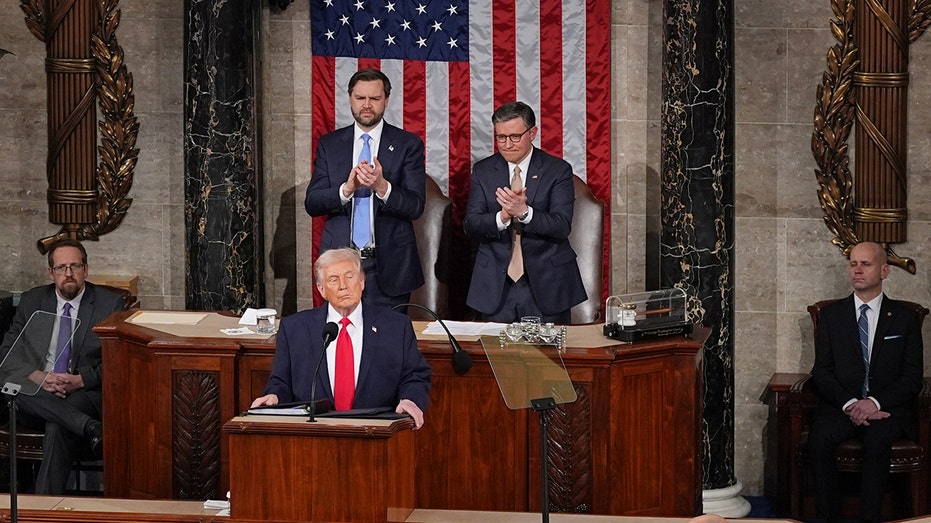
Many in Washington were expecting fireworks during President Donald Trump’s State of the Union address when he came face to face with three of the Supreme Court justices who struck down his “emergency” tariffs. Shortly after the ruling, Trump lashed out at the six justices who ruled against him, including two of his own appointees, suggesting that they were motivated by foreign interests and describing them as a “disgrace to our nation.” Would he really be able to resist the urge to attack them in a high-profile setting where they had no ability to respond?
The answer, it turns out, was “yes.” On Tuesday night, Trump criticized the ruling as “disappointing” and “unfortunate,” but he ditched the incendiary rhetoric and steered clear of a major public confrontation with the court during his primetime address. (There is an acronym for this sort of thing in some circles.)
Still, for all of Trump’s bluster after last Friday’s ruling, he has usefully — if grudgingly — underscored an essential feature of our political system in the wake of his tariff defeat: The president is bound by the Supreme Court’s rulings, even if he hates them, and he is obligated to comply with them, both as a legal and practical political matter. This statement of fact would not normally be worth lingering on, but the prospect that Trump would defy the Supreme Court has been raised both by his critics who fear encroaching authoritarianism as well as by his most ardent supporters, including the vice president of the United States.
So, where does Trump’s relationship with the Supreme Court and its conservative super-majority go from here? Among legal observers I’ve spoken to, there has been plenty of speculation about what the court’s tariff ruling — a seminal moment in Trump’s second term — might tell us.
One school of thought posits that the conservative justices, or at least the three of them who sided with the liberals in the tariff case, will find it easier to rule against Trump in the future. After all, they have now decisively bucked him on an issue of major significance to him and withstood his response, both politically and publicly.
Others worry that the conservatives will in fact find it easier to side with Trump now that they have shown a measure of independence to the public. Indeed, the court’s Republican appointees still appear poised to cripple the Voting Rights Act and to overrule a nearly century-old decision that restricts the president from firing the leaders of independent agencies created by Congress. Both outcomes would be major victories for the conservative legal movement and the GOP.
Both hypotheses have elements that ring true. The conservative justices are human, and it will not be lost on them that Trump acceded to their authority after his histrionic display of anger in the White House last week.
On the other hand, these are the same Republican appointees who created a previously nonexistent doctrine of presidential criminal immunity in the middle of the 2024 election — a decision that paved the way for Trump’s return to office — and who remain engaged in a project of constitutional reinterpretation that generally favors Republican political priorities. On balance, the actual impact of the tariff fallout on the outcomes of future cases is likely to be marginal at best.
Regardless, the Supreme Court’s ruling against Trump’s tariffs has undermined a central and explicit operating theory of the Trump administration — that, when push comes to shove, the court’s conservative super-majority will bail them out.
“We’re not winning in a lot of district courts,” Attorney General Pam Bondi said in an interview on Fox News last November about the slew of lower-court rulings against them. “When we get to the Supreme Court, the right thing happens, and that’s what matters.”
Bondi projected that same confidence in the tariff case. She accused the appeals court judges who ruled against the administration of “interfering with the President’s vital and constitutionally central role in foreign policy” and vowed to “restore the president’s lawful authority.”
The loss at the high court, however, was eminently predictable.
That is because, as I wrote over the course of the last year, the Trump administration’s legal theory was wildly unpersuasive, even on conservative legal grounds. The fact that three of the Republican appointees — Justices Clarence Thomas, Samuel Alito and Brett Kavanaugh — sided with the Trump administration in dissent does not change this. It suggests instead that these justices’ partisan leanings overrode their independent legal judgment — not the first time that this has happened and probably not the last time that it will happen.
Indeed, the Supreme Court’s conservative super-majority is likely to remain largely supportive of the Trump agenda in the coming years, just as they were an integral governing partner over the course of Trump’s first year. But the president may want to brace himself for some more high-profile losses in the coming months.
The administration should lose its bid to end birthright citizenship — which, as in the tariff case, relies on a legal argument that is starkly at odds with the relevant legal text and history and that has been roundly rejected by both the lower courts and credible legal observers across the ideological spectrum. Trump also appears likely to lose the case concerning his effort to remove Federal Reserve board member Lisa Cook, though this appears to have less to do with the merits of the case than it does with the conservative justices’ discomfort over ending the independence of the Fed and the global economic disruption that might follow.
It is always possible that the Trump administration could opt to defy, say, a Supreme Court decision against them on birthright citizenship or some other priority. After all, some of Trump’s political allies — most notably Vice President JD Vance — have been unhelpfully toying with this idea for years, as have some prominent conservative lawyers.
When the tariff decision came down on Friday, Vance described the ruling as “lawlessness from the Court, plain and simple,” but went on to concede that Trump would use different laws to try to reconstitute much (if not all) of his tariff framework. Trump himself has repeatedly told reporters that his administration would comply with court orders.
There should never have been any question about whether the Trump administration would comply with an unwelcome Supreme Court ruling, and as a political matter, it was not a good idea to flirt with the idea, either. There is practically no support for the notion among the public or most conservative legal thinkers, and outright defiance of a Supreme Court order would imperil the conservative movement’s long-term — and largely successful — project to reshape the court and constitutional law. Undermining public confidence in the court would run directly counter to that effort.
Still, none of this has put an end to concerns about the administration’s compliance with other judges’ orders — and for good reason.
Last month, the top federal judge in Minnesota tallied more than 100 court orders that had been violated by ICE, which, he wrote, had “likely violated more court orders in January 2026 than some federal agencies have violated in their entire existence.” Dozens of lower court judges across the country have likewise chastised Justice Department lawyers for failing to comply with court orders in immigration cases. Last week, the Justice Department itself disclosed that the administration had violated more than 50 orders from federal judges in immigration cases in New Jersey. (This was a self-report, so the number is almost certainly an undercount.)
Some of these instances may have been malign and intentional — as in the case of the Trump administration’s failure to comply with a court order directing them to turn around planes transporting Venezuelan migrants to the infamous CECOT prison in El Salvador. The Justice Department has been fighting for the last year to avoid having to come clean with the presiding judge over what actually happened.
In other cases, particularly more recently, the administration’s failure to comply with court orders in immigration cases appears to reflect ineptitude. Trump’s immigration crackdown has swamped the courts with challenges from detainees, and the Justice Department has clearly been unable to keep up.
If you are tempted to be sympathetic to the department’s leadership under the circumstances, you should know that they have only made the problem worse.
The endless public antics of Bondi and Deputy Attorney General Todd Blanche have angered and demoralized federal prosecutors throughout the country, and lawyers have left the department at an unprecedented rate. Bondi herself cratered morale in the U.S. Attorney’s Office in Minnesota and practically gutted the office’s criminal division when she went on one of her many tirades and fired six prosecutors in the office who objected to the department’s decision to respond to the death of Renee Good at the hands of a federal agent by investigating her widow.
A competently run Justice Department would have no problem keeping up with the legal challenges to the administration’s immigration crackdown. The department’s leaders would coordinate with federal immigration authorities ahead of their deployments and ensure that they had an adequate number of lawyers on hand in the relevant jurisdictions, even if that meant large numbers of temporary reassignments.
Clearly, that is not happening, and the result has been widespread violations of the detainees’ legal rights. The judges are right to be furious, and they are right to issue contempt findings to the lawyers involved. Many of those lawyers — including military JAG lawyers who have been roped in to help — appear to lack experience litigating in federal court or handling federal habeas cases, and they have proven unable to manage their caseloads.
Despite all this, the Trump administration’s acquiescence to the Supreme Court’s tariff ruling is a sign that at least some of the proverbial guardrails are holding. The politicians, lawyers and media figures who have worried about the second Trump administration descending into lawlessness should take some comfort here.
On top of that, the public has been paying attention, and people do not like what they have seen. Trump’s approval rating is truly terrible, and Trump’s allies in Congress appear unlikely to pass legislation to expand his tariff-setting authority in the wake of the Supreme Court’s ruling.
All of this suggests that — despite the many justifiable outrages and controversies of the last year — the laws of political gravity remain in place.








 English (US)