.png)
MUNICH — The annual security conference here — a midwinter convening of elected leaders, defense officials and the journalists who cover them — is typically consumed by the events of the present or shadowed by those of the past.
This year, however, Munich was suffused with what’s to come.
At a moment when American politics is gripped by the daily eruptions of President Donald Trump, he’s never felt more like a lame duck than he did in the corridors of the Hotel Bayerischer Hof.
There were so many potential Democratic presidential hopefuls here that it could have been the Sheraton Nashua rather than an elegant Bavarian lodge. In their public comments and private conversations, some of which were de facto bilateral meetings, Democrats ranging from California Gov. Gavin Newsom to New York Rep. Alexandria Ocasio-Cortez assured their European counterparts that Trump is temporary and the transatlantic relationship isn’t.
“It is very important that we have this much Democratic representation this year and to show that we as a party are committed to a different path,” Ocasio-Cortez told me. “Regardless of any political speculation, it is important that people are seeing a unity of that commitment to our allies and our partnerships.”
Newsom, who unlike in his trip to Davos last month brought reassurance rather than kneepads, told me that America’s longstanding relationships “are in dormancy, they’re not dead.”
The president’s principal representative here, Secretary of State Marco Rubio, delivered a speech aimed at reassuring Europe and articulating Trumpism without the rhetorical headbutt that was Vice-President J.D. Vance’s address to last year’s gathering. However, Rubio’s remarks were so compelling that they were met with a standing ovation and only served to remind Republicans and other observers across the Atlantic that he’s a far more talented political athlete than Vance — fueling another round of it-has-to-be-Marco-in-’28-right?
The European hosts, also, could not stop thinking about tomorrow. While grateful for Rubio’s open hand and Valentine’s Day plea that America and the continent “belong together,” policymakers here have been so jarred by Trump that they’re planning for a future in which they cannot rely on the U.S.
Alarmed by Trump’s threats against Greenland but perhaps emboldened by his fulfilling, again, of the TACO theory that he will inevitably back down in the face of market backlash, European leaders spoke bluntly about the administration. And more significantly, they went about discussing a sort-of NATO within the EU and the need for a nuclear umbrella outside Washington’s control.
America’s global leadership “has been challenged, and possibly squandered,” said German Chancellor Friedrich Merz, distancing Europe from “the culture war of the MAGA movement” while also taking a page from Vance last year by lecturing his American guests.
Alluding to a future of great power competition between the U.S. and China, Merz said, “NATO is not only Europe’s competitive advantage, it is also the United States’ competitive advantage.”
In other words: You need us, too.
French President Emmanuel Macron, in his remarks, said flatly that “Europe has to become a geopolitical power” and, echoing Canadian Prime Minister Mark Carney’s watershed Davos speech about middle powers, said that means “derisking vis-a-vis all the big powers in order to be much more independent.”
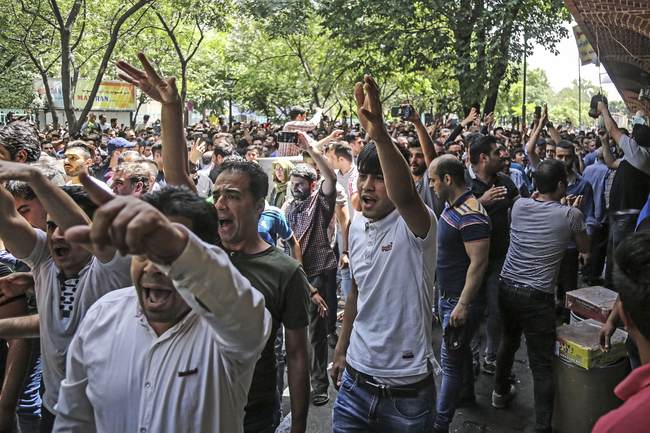
The ongoing war in Ukraine and how to bring it to a just conclusion marked many of the plenary sessions and closed-door meetings. Yet while the biggest rally outside the conference last year was a demonstration of support for their besieged European neighbor, this year over 200,000 people gathered over a conflict yet still to come — overthrowing the Iranian regime.
Chanting “democracy for Iran,” and beckoning the deposed shah’s son, who was present in Munich, the demonstrators were joined by Sen. Lindsey Graham (R-SC), who hoisted the pre-revolution Iranian flag and sported a “Make Iran Great Again” cap.
In an interview, Graham told me that if Trump and others don’t follow through on their pledge last month that help is on the way to Iran, it would mean “you can’t rely on America yet again” and “the Western world is full of crap.”
If the prospect of a new Middle East war dominated the streets of Munich, it was hard to escape American affairs within the conference.
Ever since the late Sen. John McCain made this pilgrimage a rite of the winter calendar, the MSC, as it’s shorthanded, has drawn a range of U.S. lawmakers and policy officials.
Yet rarely has American politics so clearly intruded on the proceedings.
There was Hillary Clinton on stage denouncing Trump, only to be told by a Czech official that Trump’s original victory against her was the result of the left’s “woke” excesses. (OK, so there were a few arguments from yesteryear).
And there was another New Yorker, AOC, making what was effectively her national security debut by calling for a more progressive approach to foreign policy. But her appearance may be best recalled for her halting answer on that mainstay of foreign policy: what to do about Taiwan.
And then there was Rubio, who, whether to a stadium of MAGA faithful at Charlie Kirk’s memorial service last year or a ballroom of confirmed globalists here, keeps popping up with viral remarks to remind Republicans of what could be. A list of Republicans, I should add, that includes the political theater critic in chief: Donald J. Trump.
The more immediate future, however, was on the minds of the congressional Democrats here.
Representative Jason Crow (D-CO), who may be the rare House lawmaker so bold as to bypass the Senate before seeking the presidency, had a joint press conference with AOC but sought to tamp down his not-so-subtle ambitions when I asked about 2028.
“I learned in the Army that if you’re not focused on the battle in front of you, the mission in front of you, you’re not doing the right job,” Crow told me, referring to the 2026 elections.
Nobody was happier to see potential future stars from the House show up than the most famous member of the chamber, and Munich regular, former Speaker Nancy Pelosi.
Pelosi, recalling precisely how many women in each party were in the House when she arrived in 1987, told me it was especially important for AOC to be here and for female politicians to “have a security credential.”
The former speaker, though, was far more focused on the midterms and minced no words about why Europeans should be, as well.
“I don’t want them to be [concerned],” Pelosi told me about America’s allies.
Why not? I asked.
“Because we’re going to win the elections in 10 months and Hakeem Jeffries will be speaker and there will be ways to hold in check some of what they’re going to do,” she said, alluding to the Trump administration.
Pelosi, continuing, said: “What’s hope? Hope is in what is going to come next, and that is: We will win this election, and maybe the Senate, too, if we win big enough as we’ve done in the past.”
It was a characteristically blunt assessment from somebody with such deep relationships here that she could scarcely walk between sessions without being stopped by heads of state and other high-ranking officials.
Those leaders would have been more alarmed than assured, though, by Pelosi’s matter-of-fact prediction that Trump would “of course” attempt to intervene in the midterm elections.
As the president talks about federalizing the country’s elections or somehow issuing an edict requiring states to check ID cards before people can vote, Pelosi said she and her colleagues were already planning for Trump to challenge results and perhaps not seat duly-elected winners. “We’re ready for that,” she said.
On a more distant future election, Pelosi was equally matter of fact, telling me that “yes, of course” she’ll support Newsom should her fellow San Franciscan run for president.
Newsom was mobbed as much as Pelosi, posing for selfies in between meetings that could have been mistaken for sessions between heads of state. The governor met with Merz and, in the protocol of two leaders meeting, exchanged gifts with Prime Minister Pedro Sanchez. Newsom gave the Spaniard books including The Handmaid’s Tale, assuring him that “we’re not trying to rewrite history,” and Sanchez gave the Californian a copy of Don Quixote to help him “face giants.”
Newsom’s message behind closed doors, he told me, was that “none of this is permanent” and that Trump has never been more politically weakened. He said he told European leaders that the president had been humbled on immigration, and was therefore pulling agents out of Minnesota, would soon have his tariff power constrained by the Supreme Court and would assuredly take a beating in the midterms.
In an earlier time, such comments overseas about the president from a domestic rival and leader of America’s largest state would have been extraordinary.
There’s not much shock value left to be had, though.
Trump, Newsom said, is “a wrecking-ball president.”
Paraphrasing the old Sam Rayburn line that “any jackass can kick down a barn, but it takes a good carpenter to build one,” the governor said, “We’re going to need a good carpenter” to repair America’s relationships around the globe.
I didn’t have to ask whom he had in mind.







 English (US)