.png)
 1 hour ago
3
1 hour ago
3

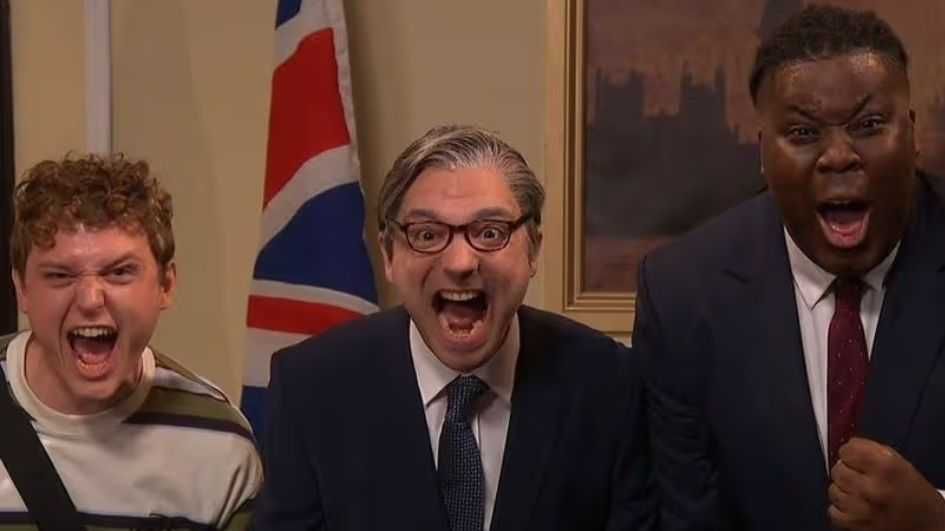
It took less than a minute. Not for the show to find its rhythm — that never arrived — but for viewers to reach for the remote.
A more generous critic would say "Saturday Night Live: UK" stumbled out of the gate. Someone actually grounded in reality would say it arrived DOA, was resuscitated by optimism, flatlined again during the opening credits, and spent the rest of its run time as evidence that nobody in the commissioning process had ever actually watched British television.
The live format, in particular, punishes British reserve. The Brits, much like the Irish, don't do collective euphoria on command.
The opening sketch — a Downing Street caricature so limp that it needed medical attention — felt like it was written by people who had heard of the place the way most people have heard of Uzbekistan: aware that it exists, entirely unclear on the details. Keir Starmer reduced to a bed-wetting schoolboy: accurate enough, but executed with all the surgical precision of a drunk toddler.
Satire requires stones. This was neutered at conception
Fey's lemon
The host was former "SNL" head writer Tina Fey — parachuted in to anchor the spin-off in the history of television's most durable comedy franchise.
Rather than evoking "Saturday Night Live," however, her appearance called to mind "30 Rock" — Fey’s own sitcom about a sketch comedy show flailing within an absurdly corporatized NBC.
She stood there less like a master of ceremonies than like a faintly embarrassed consultant, as if tasked with explaining why this seemingly gratuitous product was actually a masterstroke of synergy and brand extension. You could almost hear the Jack Donaghy pitch behind it: familiar logo, international rollout, scalable format. Somewhere between the greenlighting and the greenroom, the only premise that mattered — making people laugh — had been quietly lost.
The audience noticed immediately. They always do. Forty seconds. One minute. Five, if you were feeling charitable. The reactions weren't angry. They were worse. They were bored. There is no harsher verdict for comedy than indifference.
Stupid and sublime
It wasn’t always this way, of course. "Saturday Night Live" was once genuinely great. Not good. Not fine. Great. Belushi, Aykroyd, Eddie Murphy — dangerous, deranged, alive. Bill Murray doing a sort of dollar-store Sinatra. Chris Farley destroying every piece of furniture within reach. Phil Hartman doing impressions so precise that the subjects should have taken it personally. They probably did.
These were performers who understood that live television was a dare, not a format, and they took it every single week. Comedy that felt like it could go wrong at any moment, and sometimes did, and was better for it. Sharp, stupid, sublime in equal measure.
Those days are long gone — the show swallowed by Trump derangement syndrome and the passive-aggressive ritual of swiping at conservatives until the writers' room mistook a political position for a punch line.
In its prime, it was still political, but at least it was anchored in something real — American culture, fast, furious, and occasionally brilliant. If today's "SNL" is but a degraded facsimile of the show in its prime, this transatlantic fiasco is a facsimile of that facsimile: edges blurred, ink fading, soul entirely absent.
RELATED: 9 must-have devices for detecting leftist threats in your area
 CBS Photo Archive/Monika Graff/Getty Images
Fawlty hour
The failure here is structural, not superficial. British comedy is built on irony, understatement, and a very specific species of darkness. "Fawlty Towers." "Brass Eye." "The Office." "I'm Alan Partridge." Comedy that watches you squirm and enjoys it. Comedy that finds the precise point of maximum discomfort and builds a home there. Comedy forged in restraint and bad weather, in class anxiety and institutional distrust, in the particularly British conviction that authority is always, at some level, ridiculous. You cannot import that.
If British comedy runs on slow-burning cringe and the precise calibration of discomfort, the "SNL" format runs on volume — loud, broad, relentlessly American, built around celebrity cameos and political impressions that reset with each news cycle and evaporate by Sunday morning.
Hiring Lorne Michaels doesn't transplant the institution any more than putting a McDonald's in a country farmhouse makes it rural. The live format, in particular, punishes British reserve. The Brits, much like the Irish, don't do collective euphoria on command. They do collective embarrassment, the kind that makes you leave the room on someone else's behalf, change your name, and book a one-way ticket to the aforementioned Uzbekistan.
Nothing much
Crucially, nobody asked for this. Nobody petitioned. Nobody wrote in. Sky's decision to commission eight episodes before a single one had even aired suggests the company was already nervous — hedging against failure by pretending it was a plan.
The deeper problem is one of fundamental incompatibility — a cultural mismatch so obvious that it's almost impressive that no one in the commissioning process named it aloud. Or perhaps they did and were overruled by someone with a spreadsheet. Comedy, at its best, feels dangerous. This felt focus-grouped. Safe. Sanitized. A show that promised the sun, moon, and stars but instead delivered, with full confidence and considerable expense, a urine-scented underpass.
Of course, the next episode could be great. Revelatory. The best television in years. But judging by the first, almost anything else would have been better. Including nothing. Nothing would have been better. Nothing, at least, doesn't waste your Saturday night.





 English (US)