.png)
Iran’s repressive, clerical regime is fighting for its life. There are lots of reasons to hope that it collapses. The Islamic Republic is violent, corrupt and theocratic. It systematically discriminates against women and minorities, and its policies have led to economic disaster. When Iranians take to the streets to protest, the regime murders them. Little wonder, then, that everyone from Rep. President Donald Trump to Rep. Alexandria Ocasio-Cortez has indicated that they’d like to see the regime lose power. Trump is even considering military actions designed to make that happen. Surely, whatever comes next would be better.
Or would it?
For the last few days, I’ve been talking to people who know Iran well. They all support the protesters and oppose the current government. But they warn that anyone who expects Iran’s next regime to be democratic or peaceful may be very disappointed.
There are a few main scenarios for how the government could lose power. First, it could be deposed in a coup d’état carried out by existing officials who want to put a stop to the country’s political and economic crisis. Whatever system they set up next is unlikely to be free — coups rarely lead to democratic transitions.
Another way it might lose power would be if Supreme Leader Ali Khamenei and his deputies are toppled by the United States. But Iran has no single, unified opposition movement that can slide in and take charge if the regime’s leaders are suddenly assassinated. Instead, Iran’s opposition is divided, and its leadership is largely in jail. What’s more, Iran would lack a clear head of state if the entire regime were to suddenly disintegrate from just domestic pressure.
“The Islamic Republic does not have an alternative to it,” Vali Nasr, a professor of Middle East studies and international affairs at Johns Hopkins and a former senior adviser to the U.S. special representative for Afghanistan and Pakistan, told me. “There is no force out there that can actually take over in a day-after scenario.”
That does not mean Iran is incapable of creating one. The country’s people, Nasr said, are adept at forming civil society groups, even in the face of repression. The state has a long constitutional tradition and a history of competitive elections. It has, in other words, the ingredients needed to build democratic institutions, at least in theory.
But the regime has ruthlessly snuffed out its competition, making it impossible to cleanly replace. What comes next may therefore not be better. In fact, it could be worse.
Revolutions — the forceable, often violent toppling of a political system — have a decidedly mixed record. The American Revolution produced a democracy. But it was something of an exception. The French Revolution was followed by an era of violent turmoil and mass executions now known as the Reign of Terror. The Russian Revolution followed a similar path: The Bolsheviks ended the Romanov dynasty, only to replace it with the even-more repressive Soviet Union. None of the Arab Spring revolutions have produced a lasting democracy (although Syria’s fate is still uncertain). Iran’s 1979 revolution downed the Shah, but it created the Islamic Republic.
The Iranian revolution is a particularly sobering modern tale. When it began, there were many potential outcomes other than “theocratic dictatorship.” The Iran of then had a variety of strong social movements with long organizational traditions, each representing different social sectors. As the uprising unfurled, they largely worked together to topple the royal government. But after they succeeded, the cooperation stopped. Ayatollah Ruhollah Khomeini, the country’s leading religious figure, seized power for himself. He and his followers then proceeded to ruthlessly purge their competitors.
The result is the Iran of today. It is, admittedly, a complex authoritarian system. Unlike the People’s Republic of China or the Democratic People’s Republic of North Korea, the Islamic Republic does have actual republican elements: namely, elections to determine its president and parliament members. Those elections are not shams, in that candidates with different political beliefs compete and win. But the contests are ultimately controlled by the country’s supreme leader — first Khomeini, now Khamenei — who is an unelected cleric. The supreme leader, for example, effectively determines who is allowed to run in national elections, setting the bounds of competition. He (and it is always a he) also has direct control over a variety of institutions that shape Iran’s domestic and international path. That includes the Islamic Revolutionary Guards Corps: the preeminent branch of Iran’s armed forces.
Iranians who are opposed to the supreme leader — which, today, is most of them — still make their voices heard. That includes through mass street protests, like the ones happening now. Some particularly dedicated and courageous foes have even built followings and platforms. But the regime cracks down on protests once they reach a critical mass, and it jails opponents that get too much attention. It has thus made it hard for Iranians to build organized opposition movements that can grow and endure.
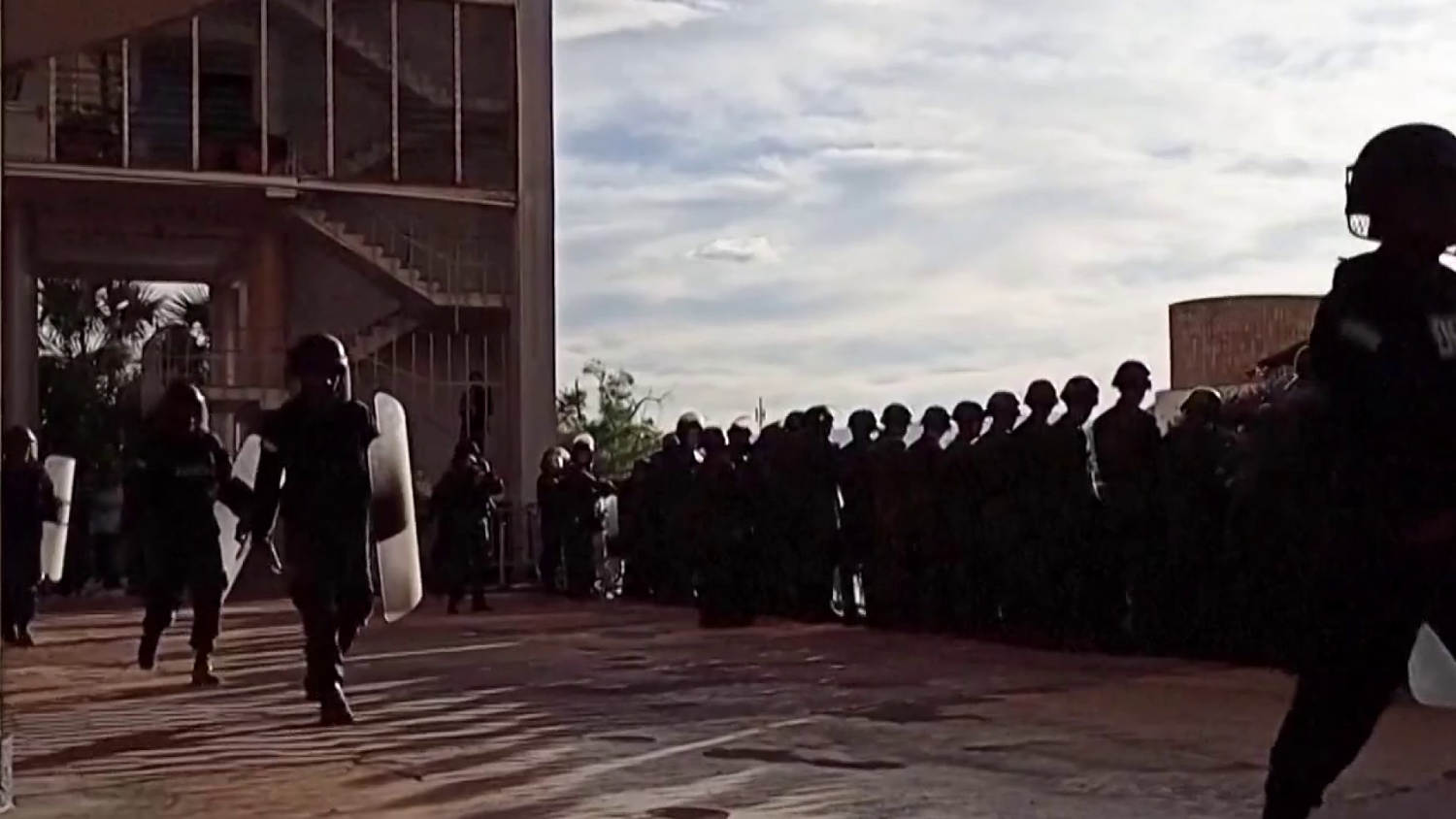
Mass protests, of course, can generate pressure whether they are organized or not. Such pressure can be particularly powerful if the protests occur with increasing frequency, as might be happening now. (It has been just under three years since the “Women, Life, Freedom” uprisings swept across the country in late 2022 and early 2023.) The Iranian regime has displayed remarkable unity in response to all these demonstrations, which is one reason why it has endured previous predictions of its demise. But when annual inflation exceeds 50 percent, as it is now, it is reasonable to wonder how many times the government can call upon security forces to fire into crowds. That is especially true for the people pulling the triggers, who are often ordinary citizens.
The most obvious coup candidates might be Iran’s mid-level military and security commanders, who have not fully benefitted from regime membership. “They are younger, and they haven’t made money yet,” said Afshon Ostovar, an assistant professor at the Naval Postgraduate School. “They’re not corrupt insiders who have made huge amounts of wealth off the system and have an incentive to sustain it.” It is thus easy to imagine these officials breaking ranks with their older superiors, or perhaps partnering with a few of them, to push Khamenei and his loyalists out.
It is much harder, however, to imagine them handing power over to a democratic government afterward. Coup leaders almost always establish dictatorships. In Iran’s case, that dictatorship could be superior to what exists now. If the military commanders are pragmatic, for example, they might try to follow the rough path charted by Saudi Arabian Crown Prince Mohammad bin Salman, who has pursued economic integration with the rest of the world and social liberalization. Such a path might not even prove terribly difficult for Iran. The country is starting from a low base and could ease much of its isolation by bargaining away its nuclear and missile programs. But MBS is, if anything, less tolerant of political dissent than is Khamenei, and an Iranian military dictatorship might be as well. It could, for instance, dissolve the country’s elected branches. Alternatively, it could keep them but repeatedly meddle and intervene, similar to what Khamenei does now. Either way, the result might be something of a draw.
Ostovar and Nasr both warn that a coup could also just produce a new clerical supreme leader who is similar to Khamenei. (The Iranian security brass and religious elite are deeply enmeshed.) Or they could name someone worse. Khamenei is, rightly, seen as an uncompromising and unyielding idealogue. But he is not actually the most extreme figure in Iran’s political apparatus. “Khamenei is an obstacle to reformists, but in a weird way he is also an obstacle to the most hardline voices,” Nasr told me. There are officials in the country’s national security and domestic branches, Nasr said, who want the country to more aggressively enforce its female dress code or be even more belligerent toward America and Israel. Iran’s 2024 presidential elections serve as evidence. The runoffs pitted the ultraconservative former secretary of the country’s supreme national security council, Saeed Jalili, against the moderate former health minister, Masoud Pezeshkian. It was an election that many outside analysts figured Pezeshkian wouldn’t win. But during the campaign, Jalili took such an aggressive line on domestic and international issues — among other things, he described mandatory veiling of women as a matter of national security — that he appeared to alienate the supreme leader. Many Khamenei confidants and advisers ultimately backed Pezeshkian, who prevailed.
Without Khamenei, Jalili might be president. And if a coup occurs, he or someone like him could lead it. Experts said that many hardliners were frustrated with Khamenei’s relatively mild response to Israel’s attacks on Iran. If the cycle of protests continues, they might look to install someone stronger.
A coup is not the only way Iran’s regime might fall. President Donald Trump has repeatedly threatened to attack the Islamic Republic if it harms demonstrators, and in a Tuesday social media post, he told Iranians that “HELP IS ON ITS WAY” and encouraged them to keep protesting. He has been briefed by advisers about potential military targets. His range of options is broad, and taking out Khamenei is probably not the default. But Trump has already decapitated one government this year, and Washington and Tehran started trading threats before most Americans were born. It is entirely conceivable that either Trump or one of his successors might order big attacks on the Islamic Republic.
In fact, what might be called the “Venezuela option” appears to be on the table. If Trump does decide to go after Iran’s leadership, he might succeed in killing or kidnapping Khamenei and certain other top figures, and then elevate someone more America-friendly. But that still doesn’t mean Iran’s new boss would be better for its people. In Venezuela, the president extracted Nicolás Maduro but left Maduro’s repressive vice president in place, on the condition, among other things, that she give U.S. companies access to Venezuelan oil. The White House could attempt something similar in Iran, replacing Khamenei with a senior Islamic Revolutionary Guards Corps commander, a regular military commander, or even a senior religious cleric who keeps the authoritarian system while agreeing to jettison parts of Iran’s nuclear program.
Another option would be for Washington to install a leader from outside the system. Many Iranians living abroad have exactly such a leader in mind: Reza Pahlavi. Pahlavi, the son of Iran’s last shah, is a fixture in the diaspora community. Over his more than 47 years of living in exile, he has built up an extensive network of monarchists across both North America and Europe. Increasingly, he seems to have built a following within Iran, as well; in videos from recent demonstrations, many protesters have chanted his name. Pahlavi, meanwhile, has promoted himself as a leader-in-waiting. He has met with Western journalists and government officials, including, recently, Trump Middle East envoy Steve Witkoff. He has delivered video addresses calling on Iranians to rise up and promising that he will return and lead a democratic transformation. He has worked with Iranians in the diaspora with scientific, economic and other kinds of expertise to create a transition plan.
But many experts are skeptical of Pahlavi. They doubted, among other things, his commitment to democratic principles. Pahlavi’s father and grandfather were authoritarians, and when asked in a recent Wall Street Journal interview about his dad’s dictatorship, Pahlavi said that “mistakes were made” before largely defending his father’s record. Pahlavi also dodged questions about whether he would serve as something more than a transitory figure. Some of the people around him, meanwhile, have proved highly divisive. In 2022, his wife insinuated on Instagram that Narges Mohammadi, an imprisoned Iranian human rights activist (and now a Nobel laureate), had ties to the Islamic Republic. And Pahlavi’s online backers are notorious for harassing his critics. As a result, only a few of the people I interviewed were willing to criticize him on the record.
Others spoke of Pahlavi himself as a nice person. But the former crown prince could struggle to manage a democratic transition even if he has the right intentions. Pahlavi has little government experience beyond what he learned watching his father. When he tried to help create a diasporic opposition coalition in 2023, during Iran’s previous wave of anti-regime protests, it collapsed. And it is unclear from the protest chants just how much support he has, and how much of that support is simply nostalgia for his non-theocratic dad. Pahlavi could still play a positive role in a transition, particularly given his name recognition. But overseeing Iran’s shift from Islamic rule would be a monumental administrative task. The country is home to over 90 million people with different beliefs and ethnic backgrounds on a land mass the size of Alaska. It will be difficult for anyone, with any level of experience, to guide the state through a fragile and transformational process.
“You might have a situation of massive chaos,” Nasr told me, citing the violence that came after America toppled Saddam Hussein in Iraq. In the worst-case scenario, the country could face internal or external warfare. After all, Iran has been invaded multiple times before, including by Saddam, who moved on the country not long after the Shah’s government fell.
None of this means the Islamic Republic can’t under any circumstances give way to a stable, democratic system. It is a nation with a long, shared history, and its people could put together a broad opposition coalition even while facing repression. History is full of big-tent groups that formed under autocracies and then proceeded to destroy them. In the 1980s, for example, Polish people with all kinds of beliefs joined Solidarity — a trade union and anti-authoritarian social movement — to resist their country’s communist government. Despite its best efforts, Warsaw was unable to shut the group down. Eventually, facing unrelenting popular pressure, it had to negotiate with Solidarity, share authority and hold elections where the communists went down. Many Latin American societies have defeated their dictatorships in roughly the same manner. Such a “pacted” transition — where struggling authoritarians negotiate with the opposition and then transfer power — could work well in Iran. The country already has strong labor groups, and repeat protests might help opposition movements institutionalize and come together.
Iran has other potential paths to a happy ending. Pahlavi claims to have contact with many defectors within the regime. If the government falls, his team could try using those connections to build a functional leadership coalition that eventually hands off power. Iran’s existing, electoral institutions could also facilitate a democratic transformation. If Iran experienced a coup, and if its new leaders face continued protests, they might conclude they are unequipped to lead the state and give more responsibility to the elected president and parliament. The next supreme leader (if Iran keeps a supreme leader) might opt to pass over control as well. Iran could soon have such a leader even without a coup or revolution. Khamenei is an 86-year-old cancer survivor.
But right now, these are longshots. There is so far little sign that the divided opposition is coalescing, or that Pahlavi is getting traction inside the regime. So it is a mistake to think that the fall of this regime will automatically produce something better. In politics, as in most of life, almost anything can get worse. It is a fact that Iranians, having lived through years of war, turmoil, and economic decay, know all too well.
“Those on the streets have thrown caution to the wind and think very much that this is a ‘now or never’ moment,” said Sanam Vakil, the director of the Middle East and North Africa program at Chatham House. But other Iranians, she said, are more fretful. “The silent majority might be a bit worried about where things go, the chaos and uncertainty of the present moment, and what the future might bring.”







 English (US)